Before the Gear Shifter: A Short History of Bicycle Gears
Bicycle gears changed how riders handled hills: see how the high wheel, chain drive and early shifting mechanisms made adjustable effort possible.
How did bicycle gears change the way a rider met a hill? The history of bicycle gears begins with a simple constraint: on a high-wheeled machine, the size of the driven wheel set how far each pedal turn carried the rider.
Pedals and wheel
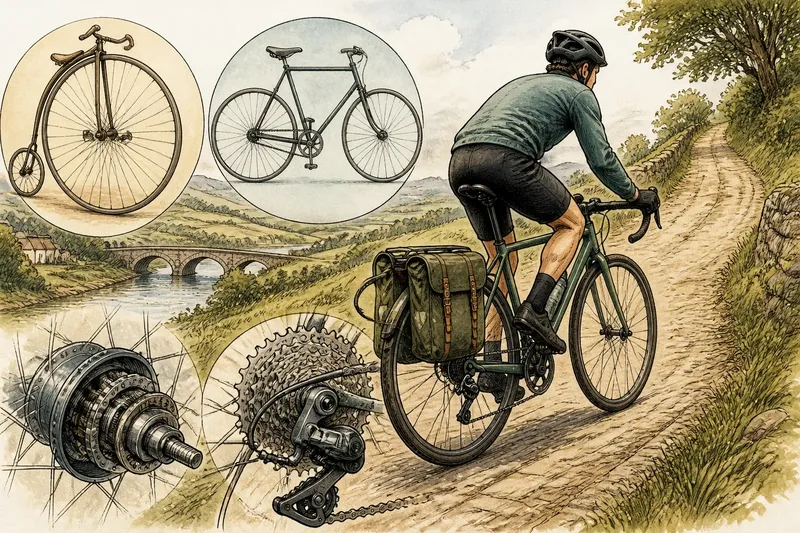
On the penny-farthing, the pedals were fixed directly to the front wheel. One pedal revolution turned that wheel once, so a larger wheel travelled further with each turn. Riders seeking more distance had to ride a taller machine, not select a different ratio.
That arrangement made gearing visible in the bicycle’s shape. A high wheel could cover ground efficiently on a clear road, but mounting and balancing it took care. The rider had no separate mechanism for making the pedals easier as the road rose.
The chain-drive shift
The safety bicycle, which became popular in the late nineteenth century, placed two wheels of similar size beneath the rider and used a chain to drive the rear wheel. The chain connected a crank-mounted chainring to a rear sprocket. Their relative sizes set the transmission ratio, independent of the wheel’s physical diameter.
This was a significant design change, but it did not immediately mean shifting while riding. A bicycle could still have a single chainring and sprocket. Makers and riders could alter those parts to suit a machine’s intended use, yet the chosen ratio remained fixed during a ride.
Say a rider used an invented safety bicycle with one chainring and one rear sprocket for a mostly level commute, then planned a route with a steep lane. Changing the sprocket before setting off could make the climb easier, but would make the same pedal turn carry the bicycle a shorter distance on the flat. The trade-off was built into the selected parts, not solved by a shifter.
Early selectable ratios
One early answer was the two-speed rear hub. The Sturmey-Archer company introduced its three-speed hub in 1902, placing the gearing mechanism inside the rear wheel’s hub. Riders could select a different ratio without moving the chain between exposed sprockets.
Derailleurs offered another route. Rather than enclosing gears in the hub, a derailleur guides the chain sideways between rear sprockets. Early designs took different forms; some required the rider to stop and reposition or reverse the rear wheel before changing ratios. Later mechanisms made shifting while riding more practical.
In 1937, the Tour de France permitted derailleur gears, a milestone in their acceptance in major road racing. That change did not make every bicycle a multi-geared machine overnight. It did, however, help establish the derailleur as a credible way to adapt gearing to a route while riding.
What the mechanism changed
A derailleur system typically combines a rear derailleur and a cassette or freewheel of sprockets. On bicycles with multiple chainrings, a front derailleur shifts the chain between them as well. The rider operates shifters at the handlebars, and easing pedal pressure briefly helps the chain move without being forced hard against its teeth.
An internal hub works differently. Its gears sit inside the rear hub, so the external chain stays on the same sprocket as ratios change. The design keeps the shifting mechanism enclosed, while a derailleur system uses visible sprockets and a chain that moves across them. Each approach reflects a different way to offer more than one ratio.
Bicycle gears questions?
Why did the high wheel need a large front wheel?
Its pedals turned the driven wheel directly, so increasing wheel size increased the distance covered per pedal revolution. The design linked gearing to the bicycle’s height.
What did the safety bicycle change?
Its chain drive let designers set the ratio with the chainring and rear sprocket rather than the diameter of a directly driven wheel. That made a practical frame compatible with different fixed ratios.
How does a derailleur change the ratio?
It moves the chain between sprockets of different sizes. The new chain position changes how the crank’s rotation relates to the rear wheel’s rotation.
How is a hub gear different?
A hub gear changes the ratio through a mechanism enclosed inside the rear hub. The chain does not shift sideways across a cluster of rear sprockets.
Effort on the road
A lower gear makes the pedals easier to turn but moves the bicycle a shorter distance with each turn. A higher gear does the opposite. Neither removes the effort of a climb or a headwind; it changes how that effort meets the pedals.
Imagine a rider on an invented bicycle with derailleur gears, carrying a loaded pannier from a flat riverside path towards a steep lane. Before the slope, the rider eases pressure on the pedals and shifts to a larger rear sprocket. The pedals then turn more easily, though the rider must make more revolutions to cover the same stretch. Once the road levels, shifting to a smaller rear sprocket makes each pedal turn carry the bicycle further. The resulting choice is clear: easier turning for the climb, or more distance per turn on the flat.
The history of bicycle gears is therefore not just a sequence of parts. It is the story of moving the ratio from the bicycle’s fixed shape into a mechanism the rider could select. That change let one bicycle respond to different stretches of road without asking its rider to stop and rebuild the drive system.